Our Complete Guide to Trailer Flip Axles–and When You Should Use Them
In this article:
Heavy hauling is full of challenges. Of course, we don’t have to tell you that.
From weight limits to loading heavy equipment, every haul is a critical component to your success. Failure could not only impact your profit, but also damage your reputation so you won’t get the jobs you want and need.
Trailer flip axles are a vital component of meeting these challenges. They can help your trailer meet stringent state weight and length requirements. They’re versatile, and if your hauls concentrate on construction and heavy equipment, a trailer flip axle is a vital asset.
At Pinnacle Trailers, we understand that every haul is important. You can’t afford to have your trailer in the shop. It’s also disastrous to have the wrong trailer; it will keep you from getting the right hauls for your business. That’s why we not only work with you to get the right trailer, but when you purchase a trailer from us, we’ll always be there for you. If you ever need repairs, our experienced technicians will get you back on the road ASAP with as little downtime as possible. We invite you to check out our inventory and contact us for information.
In this article, we’ll take a closer look at trailer flip axles, what they are and when you should use them. We’ll also examine what is required to use a flip axle and what they can add to your capacity.
What Is a Trailer Flip Axle?
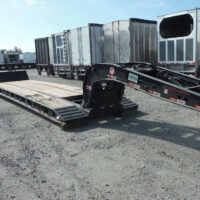
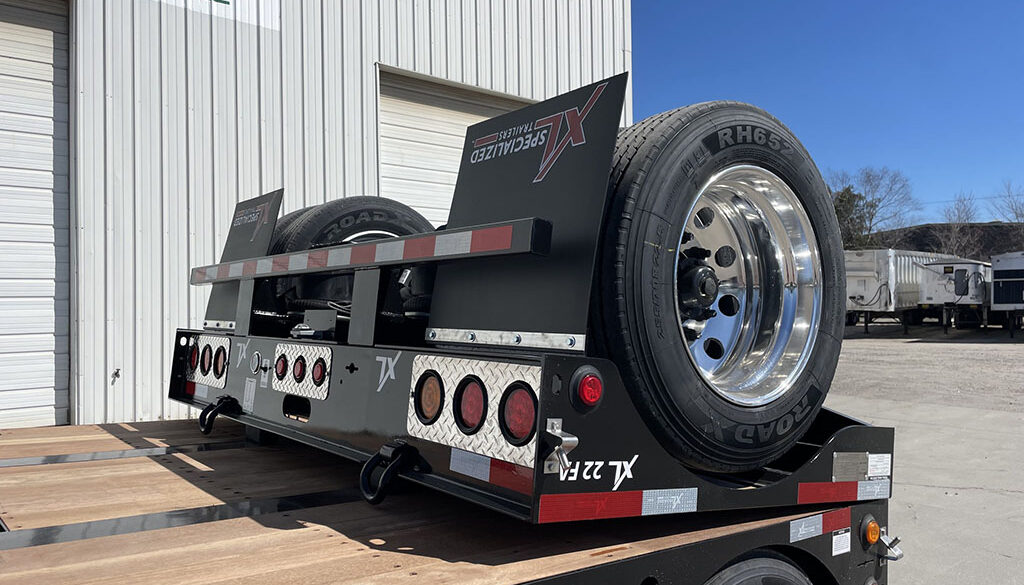
This is a heavy-duty trailer that has a set of wheels that is easily moved. Therefore, it can easily be flipped out of the way and only engaged when necessary. Flip axles would be used as a 3rd , 4th or 5th axle.
The main advantage is that this addition enables you to handle heavy loads. It also has other advantages. You can turn corners more easily and because it distributes weight along a larger area, you can meet state weight per axle requirements. Because of this, you can also avoid tolls or the need for additional permitting.
When not being used, the axle is easily folded onto the rear deck.
When Is It Required to Use a Flip Axle?
A trailer flip axle is needed whenever your axle loading exceeds the state’s gross weight allotment. These axles are also needed to meet certain bridge requirements. In addition, if you go to a weigh station, you may be required to put the axle down.
What Types of Trailers Can Use Flip Axles?
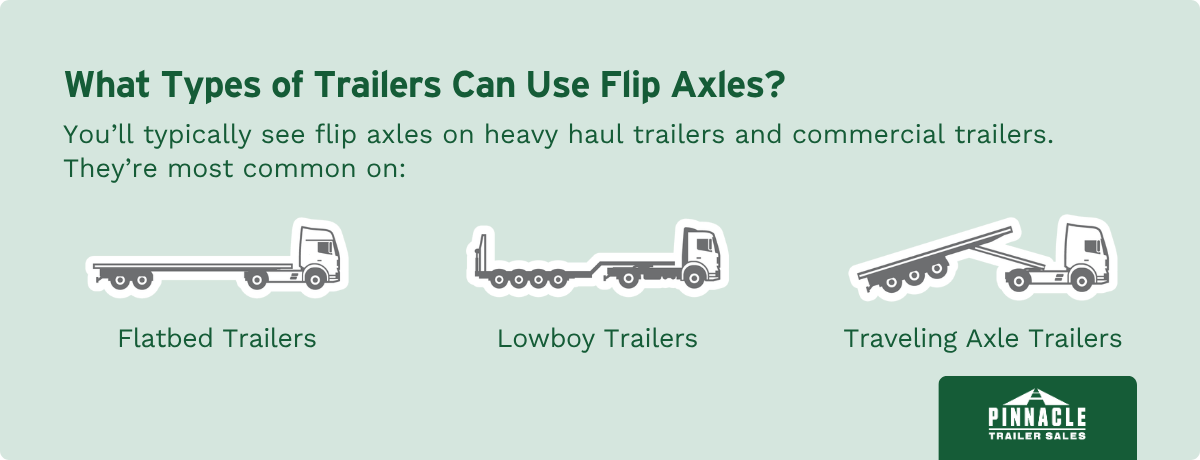
You’ll typically see these on heavy haul trailers and commercial trailers. They’re most common on lowboys, flatbeds and traveling axle trailers.
How Much Payload Capacity Do Flip Axles Help Add?
There is no one fixed answer to this. The payload actually depends upon several factors, such as your trailer set up, axle ratings and whether or not you’re operating under state or federal regulations.
No Matter What Type of Trailer You’re Looking for, We Have What You Need for the Right Haul
We support you long after the purchase.
You see, we view ourselves as a partner in your success. Our greatest moments of satisfaction are not in profits or spreadsheets, but in the enthusiasm of our customers when they get that important job or the ideal haul.
Our dedication to customer service and our experienced technicians make all the difference. Not sure what you need? Contact us and we’ll be glad to help.
Key Takeaways
- A trailer flip axle is a movable axle that can be folded up when not needed or deployed to share the load.
- Flip axles help distribute weight across a larger area, making it easier to meet state per-axle weight requirements.
- You’re required to deploy a flip axle whenever your current axle configuration would exceed the state’s gross weight allotment, certain bridge requirements, or weigh station rules.
- Flip axles are most commonly found on heavy haul trailers, including lowboys, flatbeds, and traveling axle trailers.
- The added payload capacity from a flip axle varies based on your trailer setup, axle ratings, and applicable state or federal regulations — there’s no single fixed number.
=====
Sources:
Federal Highway Administration, “Compilation of Existing State Truck Size and Weight Limit Laws,” https://ops.fhwa.dot.gov/freight/policy/rpt_congress/truck_sw_laws/app_a.htm